The goldilocks principle: is 20% protein “just right” for brown bears?
Citation
Christian AL, Robbins CT, Tollefson TN, Carnahan AM, McCleary JM, Huriega AG, and Barboza PS. 2025. The goldilocks principle: is 20% protein “just right” for brown bears? In Treiber K, Brooks M, D’amato-Anderson J, Nylander J, Eds. Proceedings of the Sixteenth Conference on Zoo and Wildlife Nutrition, AZA Nutrition Advisory Group, Oklahoma City, OK.
Abstract
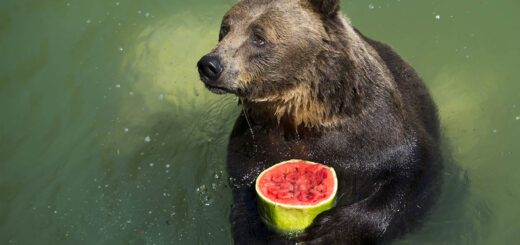
Brown bears (Ursus arctos) under managed care prefer energy-rich diets that are moderate in protein (~20% crude protein [CP], dry matter basis). However, free-ranging bears exploit pulses of low-protein plants and high-protein prey in summer. Do bears experience tradeoffs at the lower or upper bounds of protein within the range of their natural diets during their active season? We examined digestive and metabolic responses in brown bears consuming diets below (11% CP) and above (37% CP) the proposed optimum level of 20% CP, simulating a natural range of protein loads. We fed eleven adult, non-reproductive bears (4 males: 180–290 kg; 7 females: 145–200 kg) three isocaloric diets (20 – 22 KJ/g) at two intake levels (Maintenance and 2×Maintenance) in each of three time periods over summer (May, July, August). Digestibilities of energy and protein were high (>78%) and unaffected by intake level or period. Total energy expenditure and body energy gain were also unaffected by protein intake, but energy expenditures declined over summer (42.5 – 22.1 MJ kg-0.75 d-1), increasing the rate of energy gained as fat (0.35 – 0.56 MJ kg-0.75 d-1). Conversely, bears maintained lean mass over an eight-fold range of protein intake (2.8 – 22.2 g kg-0.75 d-1) through summer. Protein intake increased water turnover, plasma osmolality, and blood urea concentrations; however stable levels of plasma creatinine indicated maintenance of renal clearance. Brown bears achieve omnivory by conserving body protein at low protein loads and by increasing water turnover at high protein loads. Bears prioritize energy intake while exploiting resource pulses that vary in protein concentration, resulting in a diet that is, on average, moderate in protein. Feeding a moderate protein diet may safeguard growing or reproductive bears from deficiencies, and geriatric or diseased bears from excess nitrogen. Bears in zoos may benefit from changes in food quantity and composition that mimic foraging in the wild to facilitate natural seasonal adjustments in energy and nitrogen metabolism.
 ChristianBrownBearZN2025S2.pdf 150 KB